The Sound of Nothing: How a Japanese Approach to Silence Is Pulling Gen Z Off the Audio Treadmill
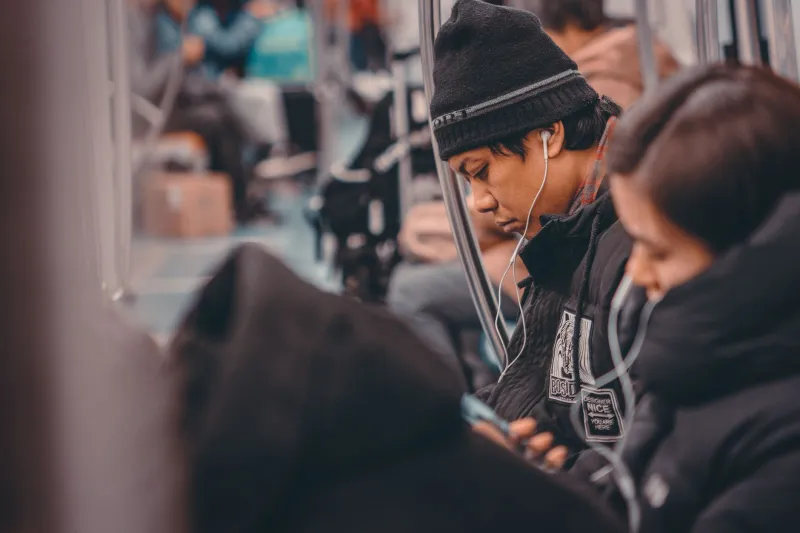
Somewhere on a Brooklyn subway platform, a 22-year-old named Maya is doing something that would have seemed almost rude just three years ago. She's standing still, headphones around her neck, not playing anything. No podcast. No playlist. No white noise app simulating a Tokyo café in the rain. She's just... listening to the platform.
The squeal of brakes. Someone's sneakers on tile. A toddler narrating the arrival of a train to no one in particular.
"I felt kind of naked the first few times," she admits. "But then I started actually noticing stuff. Like, the city has a rhythm. I'd just been drowning it out for years."
Maya isn't alone. Across the country, a quiet — and we mean that literally — shift is happening among younger Americans who are pulling back from the relentless audio stimulation that defined millennial and early Gen Z life. And the philosophy underpinning this shift? It's got deep roots in Japan.
Ma: The Space Between the Notes
In Japanese aesthetics, there's a concept called ma (間) — often translated as "negative space" or "pause," but really it's richer than either of those words suggest. Ma is the meaningful gap. The silence between two lines of a poem that makes the words land harder. The breath before a taiko drum strike. The empty corner of a room that lets the furniture breathe.
Japanese design, music, architecture, and even conversation have long honored ma as an active element — not an absence, but a presence in its own right. Silence, in this framework, isn't what happens when sound stops. It's something you can actually inhabit.
That's a very different relationship with quiet than most Americans grow up with. In the US, silence tends to get treated like a problem to be solved. Waiting rooms have TVs mounted in every corner. Elevators pipe in music. The cultural assumption is that empty sonic space is uncomfortable, even vaguely threatening — something to be filled as quickly as possible.
For a generation raised on autoplay and algorithm-driven queues, that assumption got baked in early. But cracks are starting to show.
The Headphone Hangover
Here's the thing about noise-canceling headphones: they're extraordinary technology. And they've also quietly (irony noted) contributed to a kind of sensory isolation that a growing number of young people are starting to push back against.
Studies over the past few years have flagged rising rates of noise-induced hearing concerns in younger age groups — the World Health Organization has pointed to unsafe listening habits as a growing public health issue. But beyond the audiological stuff, there's something more diffuse happening. A kind of mental fatigue from never actually being in a place.
When you're noise-canceling your commute, your lunch break, your walk through the park — you're technically present but acoustically absent. You're there and not there at the same time. And increasingly, Gen Z is naming that experience as a source of low-grade disconnection they can't quite shake.
"I used to think I was being productive," says Jordan, a 24-year-old in Chicago who started doing "audio-free mornings" six months ago. "Podcast on the way to work, playlist while I made coffee, YouTube in the background while I answered emails. But I was never actually anywhere. I was just consuming."
Silent Commutes and Noise-Free Spaces
The response has taken a few different shapes. On TikTok and Reddit, "silent commute" content has been picking up steam — videos of people simply riding trains or walking through cities without earbuds, often captioned with observations about what they noticed. A dog wearing a little sweater. The way light hits a building at 8 a.m. The surprisingly soothing rhythm of a city waking up.
Some friend groups have started designating noise-free hangouts — meetups where nobody puts on background music, nobody has a video running on a laptop in the corner. Just people, talking or not talking, in actual acoustic space together. It sounds almost aggressively low-key, but participants consistently describe these gatherings as feeling more connected than their louder equivalents.
There's even a small but growing interest in shizukesa (静けさ) — the Japanese quality of tranquil stillness — as a kind of lifestyle orientation. Not minimalism exactly, and not meditation in the formal sense. More like a deliberate cultivation of quiet as an environmental condition.
Japanese temple towns, forest bathing (shinrin-yoku) practices, and the hushed interior worlds of traditional teahouses have long understood that the right kind of quiet doesn't feel empty — it feels full. That's the register a lot of younger Americans seem to be reaching for, even if they're doing it on a fire escape in Queens rather than a cedar forest in Kyoto.
What Silence Actually Does to Your Brain
The neuroscience here is genuinely interesting. Research has suggested that periods of quiet — real quiet, not just "quieter" — can support memory consolidation, creative thinking, and emotional regulation in ways that constant audio input doesn't allow. Your brain needs downtime that isn't just sleep. It needs wakeful quiet to process, integrate, and wander.
And wandering turns out to be valuable. The mental state associated with mind-wandering — sometimes called the default mode network — is linked to creativity, empathy, and self-reflection. It's the mode you slip into when you're not being directed by external input. Constant audio stimulation essentially keeps that mode locked out.
For a generation navigating intense external pressures — economic anxiety, social media performance, the ambient noise of a world that seems perpetually on fire — the ability to access internal quiet might be less of a luxury than a genuine survival skill.
Rebellion in a Minor Key
There's also something quietly countercultural about this whole thing. Productivity culture has spent years telling us that idle ears are the devil's workshop — that every commute is an opportunity to learn something, every workout a chance to consume content, every spare moment a unit of potential optimization.
Choosing not to fill those moments with audio is, in a small but real way, opting out. It's saying: my attention isn't always a resource to be allocated. Sometimes it's just mine.
That framing resonates with the broader Gen Z pushback against hustle culture and the commodification of every waking hour. Silence, weirdly, has become a form of resistance.
Ma would probably approve.
Finding Your Quiet
If you're curious about trying this, the entry point is lower than you'd think. You don't need a meditation practice or a trip to a Japanese mountain town (though, honestly, dream trip). You just need to leave the headphones off for one commute. Take a walk without a soundtrack. Sit in your kitchen in the morning before you open anything.
Notice what the world sounds like when you let it.
It might feel weird. It might feel boring. Or it might feel, after a few minutes, like arriving somewhere you didn't know you'd been missing.
The silence has been there the whole time. You just have to stop drowning it out.