Gold Seams and Good Taste: Why Gen Z Is Wearing Their Wear-and-Tear With Pride
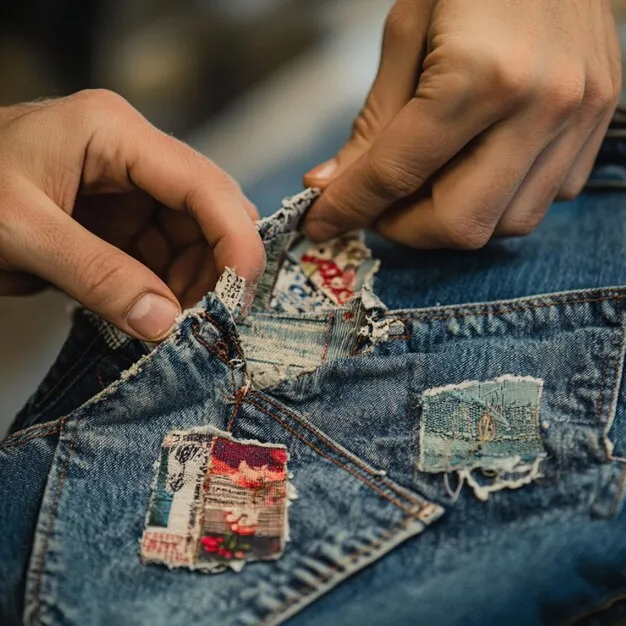
Photo: person sewing patch on denim jeans close up colorful thread repair, via img.freepik.com
There's a pair of jeans making the rounds on TikTok right now. The knees are blown out — not in a factory-distressed, straight-off-the-rack kind of way, but in a genuinely, authentically destroyed kind of way. The owner patched them with mismatched denim scraps, hand-stitched in bright yellow thread. The caption? "Fixed them myself. They're better now."
The video has over two million views.
Somewhere between the thrift-flip era and the anti-fast-fashion movement, a quiet philosophy from a Japanese pottery studio has become one of the most influential ideas in American youth culture. Kintsugi — the centuries-old practice of repairing cracked ceramics with lacquer mixed with gold, silver, or platinum — teaches that breakage is part of an object's history, not something to hide. The repair is the beauty. And Gen Z? They've taken that idea and run straight to their local fabric store with it.
What Kintsugi Actually Is (And Why It Hits Different Now)
Kintsugi translates roughly to "golden joinery." The practice dates back to 15th-century Japan, rooted in the broader aesthetic philosophy of wabi-sabi — the acceptance of transience and imperfection. When a tea bowl cracked, a skilled craftsperson wouldn't toss it or hide the damage with invisible glue. They'd fill the fracture with gold, making the repaired piece arguably more beautiful — and more valuable — than the original.
That's a genuinely radical idea, especially when you hold it up against the dominant logic of American consumer culture, which has spent decades telling us that worn means worthless and new means better.
For a generation that grew up watching fast fashion collapse under its own ethical weight — sweatshop exposés, landfill footage, the Shein discourse — kintsugi offers something that feels almost spiritually corrective. It's not just a repair technique. It's a whole different way of thinking about objects, time, and value.
The TikTok-to-Runway Pipeline
The visible-mending movement has been quietly building for years in crafting communities, but it hit critical mass somewhere around 2022 when creators started framing their repairs not as necessity but as choice. Stitched-up sneakers. Embroidered tears in vintage flannels. Jeans repaired with sashiko — the traditional Japanese running-stitch technique — in bold geometric patterns. The aesthetic is deliberate, artful, and unmistakably intentional.
And the fashion industry noticed fast.
Luxury brands, never ones to miss a cultural moment, started selling the concept back at a premium. Maison Margiela has long played with the idea of "artisanal" distressing. Newer labels have released pieces with exposed, exaggerated stitching as a design feature — charging four figures for jackets that look like they've been repaired by a very expensive hand. The irony isn't lost on anyone. What began as a reaction against overconsumption has, in certain zip codes, become its own form of conspicuous spending.
But here's the thing: for most of the Gen Z creators driving the trend, the whole point is doing it yourself. A $1,200 "artfully distressed" blazer from a designer brand is aesthetically adjacent to kintsugi, but philosophically, it's missing the point entirely. The value — the gold, so to speak — is in the labor, the story, the specific human being who sat down and decided this thing was worth saving.
Sashiko, Boro, and the Japanese Roots Running Deep
Kintsugi isn't the only Japanese tradition feeding this moment. Boro — the practice of patching and repatching textiles until they become layered, almost quilt-like objects of accumulated history — has become a genuine reference point for American upcyclers. Japanese boro pieces from the 18th and 19th centuries, once considered peasant objects, now sell for thousands of dollars in vintage markets. The story they tell is right there on the surface.
Sashiko, traditionally a functional reinforcement stitch used in workwear and fishing garments, has exploded as a craft on YouTube and Instagram. American beginners are buying kits, learning the patterns, and applying them to everything from torn thrift-store denim to worn-out tote bags. There's something quietly powerful about reaching back into a centuries-old craft tradition and finding that it solves a very 21st-century problem.
The Flex Is in the Philosophy
What makes this whole thing fascinating from a cultural standpoint is the inversion of status it represents. For most of recent fashion history, pristine was powerful. Unworn sneakers in their original box. Tags still on. The flex of the untouched.
Kintsugi culture flips that. The flex now is evidence of use, care, and intentionality. A pair of sneakers that's been resoled twice and hand-painted after a scuff isn't a consolation prize — it's a statement. It says: I know what I have. I chose to keep it. I made it mine.
There's also a generational values layer here that's hard to ignore. Gen Z consistently ranks sustainability as a top concern, but they're also deeply allergic to performative environmentalism that doesn't hold up under scrutiny. Kintsugi-inspired fashion is the opposite of a tote bag that says "eco-friendly" while the brand pumps out 40 new styles a week. It's material proof of a different relationship with stuff.
So What Does This Actually Look Like in 2025?
In practical terms, the kintsugi economy looks like this: thrift stores are getting picked cleaner and faster than ever, but buyers are looking for pieces with potential rather than perfection. Embroidery floss is a legitimate hot commodity. Cobbler shops in major cities are reporting a surge in younger customers — people who've never owned a pair of shoes worth resoling before, coming in with beat-up Nikes and asking what can be done.
Online, communities like r/Visiblemending and countless TikTok repair accounts have built genuine audiences around the idea that the process is as worth sharing as the result. The before-and-after isn't just satisfying — it's the whole story. The crack, the repair, the gold.
That's kintsugi. And in a culture that's been told to throw everything away and buy it new, choosing to find the beauty in the break might just be the most radical thing in anyone's closet right now.