Empty Space Is the New Self-Care: How Ancient Japanese Ideas Are Saving Gen Z From the Internet
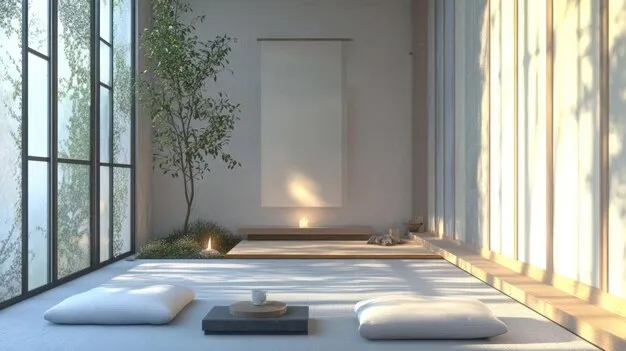
Photo: minimalist Japanese room with natural light and empty space, via img.freepik.com
Somewhere between the forty-seventh TikTok of the day and the third unskippable ad, something snapped for a lot of people. Not dramatically — more like a slow, creeping realization that the noise had gotten too loud. And the response, weirdly enough, hasn't been to log off entirely. It's been to look east.
Japanese concepts that have existed for centuries — ma, wabi-sabi, mono no aware — are quietly becoming the vocabulary of a generation trying to figure out how to exist online without completely losing themselves. And unlike the sleek, Instagram-white minimalism wave that crested around 2015, this one feels less like an aesthetic and more like an actual lifeline.
What's Ma Got to Do With It?
Let's start with ma (間), because it might be the most radical idea flying under the radar right now. In Japanese art, architecture, and music, ma refers to negative space — the meaningful pause, the deliberate gap, the breath between notes. It's not emptiness as absence. It's emptiness as intention.
For American creatives raised on the content treadmill, that distinction hits different. A graphic designer in Portland described her discovery of ma as "finding out that the white space in my designs wasn't a mistake — it was actually doing the most work." She started applying the concept beyond her Illustrator files: fewer posts per week, longer gaps between projects, actual silence during her mornings. Her engagement didn't tank. Her anxiety did.
This is the pattern showing up across creative communities right now. TikTok creators who built audiences on daily uploads are experimenting with posting less but with more intention. Interior designers are stripping rooms down not to look cool but to literally breathe easier. Wellness influencers are swapping the 47-step morning routine content for something harder to film: stillness.
Wabi-Sabi and the War on Perfection
If ma is about space, wabi-sabi (侘寂) is about imperfection — and it might be the concept Gen Z needed most desperately. The philosophy finds beauty in the cracked, the weathered, the incomplete. A chipped ceramic mug. A garden that's gone a little wild. A life that didn't turn out according to plan.
In a cultural moment where filters are getting more sophisticated and AI can smooth out every flaw, wabi-sabi functions almost as counter-programming. It's the philosophical foundation behind the "raw" aesthetic trend — unedited photos, messy bookshelves shown proudly on camera, the deliberate choice to leave in the rough edges.
What's interesting is how this differs from the vulnerable-content trend of a few years back, where creators would perform messiness while still maintaining tight narrative control. Wabi-sabi as younger creators are practicing it is less performative. It's more about genuinely releasing the grip on perfection than staging its absence. That's a subtle but meaningful shift.
Marie Kondo's tidying method, which swept through American households in the late 2010s and got its own Netflix moment, planted early seeds of this thinking — though Kondo herself has noted that her philosophy was often reduced to a decluttering hack rather than understood as a spiritual practice rooted in Shinto ideas about objects having energy. The current wave of practitioners seems more interested in the philosophy than the folding technique.
This Isn't Your Older Sibling's Minimalism
Here's where things get genuinely interesting: the minimalism of the 2010s was, in retrospect, still pretty maximalist in its ambitions. It wanted to be a lifestyle brand. It wanted matching linen everything and a capsule wardrobe and a very curated bookshelf. It was minimalism as content.
What's happening now is messier and harder to photograph. It's someone deciding not to buy the trending Stanley cup because they already have a water bottle that works fine. It's choosing to sit with a feeling instead of immediately making a video about it. It's reading a physical book with the phone in another room — not because some productivity guru said to, but because it turns out that's just nicer.
The Japanese framework gives this impulse a language and, maybe more importantly, a history. These aren't new ideas cooked up by a wellness startup. They're concepts that have been refined across centuries of art, architecture, tea ceremony, and everyday life. For a generation that's deeply skeptical of trends and brand-packaged self-improvement, that lineage matters.
The Practice, Not the Aesthetic
What practitioners keep emphasizing is the distinction between using these ideas as decoration versus using them as actual tools. Hanging a print with wabi-sabi written on it is one thing. Genuinely sitting with the discomfort of an unfinished project instead of abandoning it or over-polishing it is another.
The ma principle applied to social media isn't just posting less — it's about what the space between posts actually contains. Is it rest? Creative incubation? Real-world experience that will eventually feed back into the work? Or is it just anxiety about not posting?
These questions are the real substance of what's shifting. And they don't have easy, content-friendly answers, which is maybe exactly the point.
The digital burnout conversation has been happening for years, cycling through dopamine detoxes, digital sabbaths, and app-limiting tools. What Japanese minimalist philosophy offers that those solutions don't is a reframe: it's not about fighting the noise. It's about cultivating such a genuine relationship with quiet that the noise loses some of its pull.
Where This Goes Next
It would be easy — and probably wrong — to predict that this becomes the next big lifestyle trend, packaged and sold back to the people it's meant to help. Some of that will inevitably happen. But the core ideas are sturdy enough to survive the trend cycle, because they were never really about the trend cycle to begin with.
For now, the most honest version of this movement looks like small, private choices. A cleared desk. A longer exhale. A post that didn't get made because the moment was worth keeping. In a culture that monetizes everything, that might be the most radical act of all.
Hey Hoku will be watching — from a respectful, ma-appropriate distance.